What is the difference between a Coffee Wood Marble block and a slab?
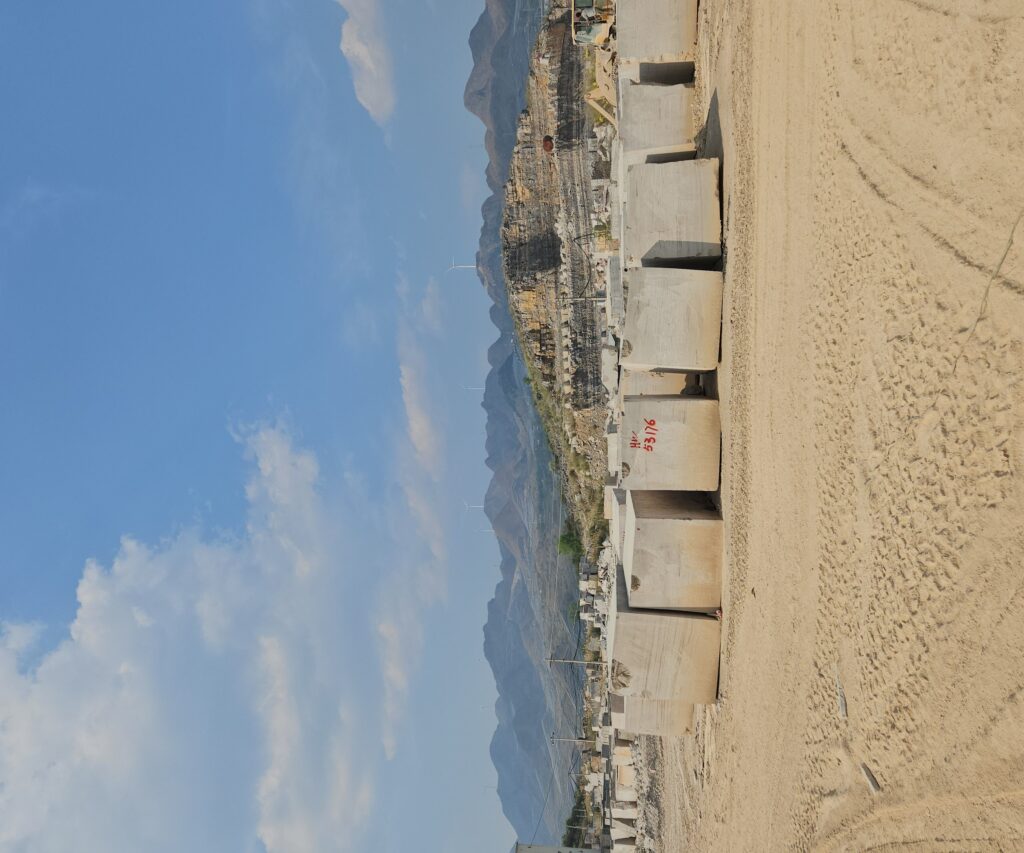


Reference photographs. They show the material and the finish; they are not photographs of goods we made, and the colour on screen is not a colour-match.
The figures, and where each one comes from
| Block | Slab | |
|---|---|---|
| What it is | As quarried, roughly dressed | Sawn from the block and polished on one face |
| Size | About 1.5–2.5 m long, 0.6–1.5 m wide | 2400 × 1600 mm, or to the block |
| Thickness | Several hundred millimetres | 18, 20 or 30 mm |
| The figure | Only visible on the sawn ends | Running the length of the slab |
| What it becomes | Cut into slabs | Tiles, panels, tops, steps |
Why it behaves the way it does
A block is the whole of the story of the stone and a slab is one reading of it. The block carries the figure in three dimensions, and the saw decides which plane through it the room will see — which is why the choice of block and the choice of cut happen together.
What these figures are, and what they are not
We supply slabs and cut-to-size, and we buy blocks. We do not supply rough blocks.
If you are specifying this
We have not published products against this question yet. Send us the process, thickness and quantity and we will quote it against what we can actually form, rather than against a catalogue.
A block is the piece that comes out of the quarry, roughly rectangular and unsawn on its faces. A slab is what the block becomes at the saw: one face polished, the block cut into boards of a given thickness, each with the figure running the length of it.
The figures
| Block | Slab | |
|---|---|---|
| What it is | As quarried, roughly dressed | Sawn from the block and polished on one face |
| Size | About 1.5–2.5 m long, 0.6–1.5 m wide | 2400 × 1600 mm, or to the block |
| Thickness | Several hundred millimetres | 18, 20 or 30 mm |
| The figure | Only visible on the sawn ends | Running the length of the slab |
| What it becomes | Cut into slabs | Tiles, panels, tops, steps |
Why
A block is the whole of the story of the stone and a slab is one reading of it. The block carries the figure in three dimensions, and the saw decides which plane through it the room will see — which is why the choice of block and the choice of cut happen together.
What these figures are, and what they are not
We supply slabs and cut-to-size, and we buy blocks. We do not supply rough blocks.