How do I care for a Coffee Wood Marble floor?
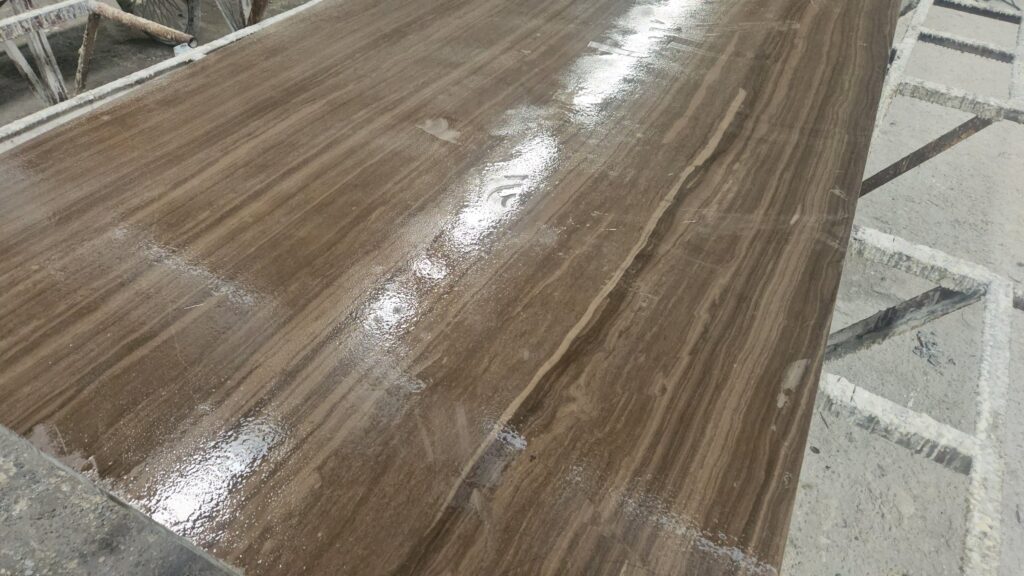

Reference photographs. They show the material and the finish; they are not photographs of goods we made, and the colour on screen is not a colour-match.
The figures, and where each one comes from
| Do | Why |
|---|---|
| Dust-mop or vacuum with a hard-floor setting every day | Grit is abrasive and it is the main cause of scratches |
| Mop with a pH-neutral cleaner and dry it | Acid dulls the surface; water left standing leaves marks |
| Blot a spill rather than wiping it | Wiping spreads it across the stone |
| Put a mat at the entrance | It catches most of what gets tracked in |
| Never use vinegar, lemon juice or scouring powder | They etch the surface, and an etch has to be polished out |
Why it behaves the way it does
The two failures are confused because both look like a dull patch. A scratch is a groove and it can be buffed; an etch is a chemical reaction with the calcite and it cannot. The difference is worth holding on to, because the first is a maintenance job and the second is a repair.
What these figures are, and what they are not
This is general guidance for calcareous stone. A floor in a hotel kitchen or a shower needs a programme written for that floor, and the sealer's manufacturer has the product-specific intervals.
If you are specifying this
We have not published products against this question yet. Send us the process, thickness and quantity and we will quote it against what we can actually form, rather than against a catalogue.
Sweep grit off daily, mop with a pH-neutral stone cleaner, and never use vinegar, lemon or an abrasive powder. Grit under a shoe is what scratches a marble floor; acid is what etches it. Those are two different problems and two different habits.
The figures
| Do | Why |
|---|---|
| Dust-mop or vacuum with a hard-floor setting every day | Grit is abrasive and it is the main cause of scratches |
| Mop with a pH-neutral cleaner and dry it | Acid dulls the surface; water left standing leaves marks |
| Blot a spill rather than wiping it | Wiping spreads it across the stone |
| Put a mat at the entrance | It catches most of what gets tracked in |
| Never use vinegar, lemon juice or scouring powder | They etch the surface, and an etch has to be polished out |
Why
The two failures are confused because both look like a dull patch. A scratch is a groove and it can be buffed; an etch is a chemical reaction with the calcite and it cannot. The difference is worth holding on to, because the first is a maintenance job and the second is a repair.
What these figures are, and what they are not
This is general guidance for calcareous stone. A floor in a hotel kitchen or a shower needs a programme written for that floor, and the sealer’s manufacturer has the product-specific intervals.