Does Coffee Wood Marble stain?
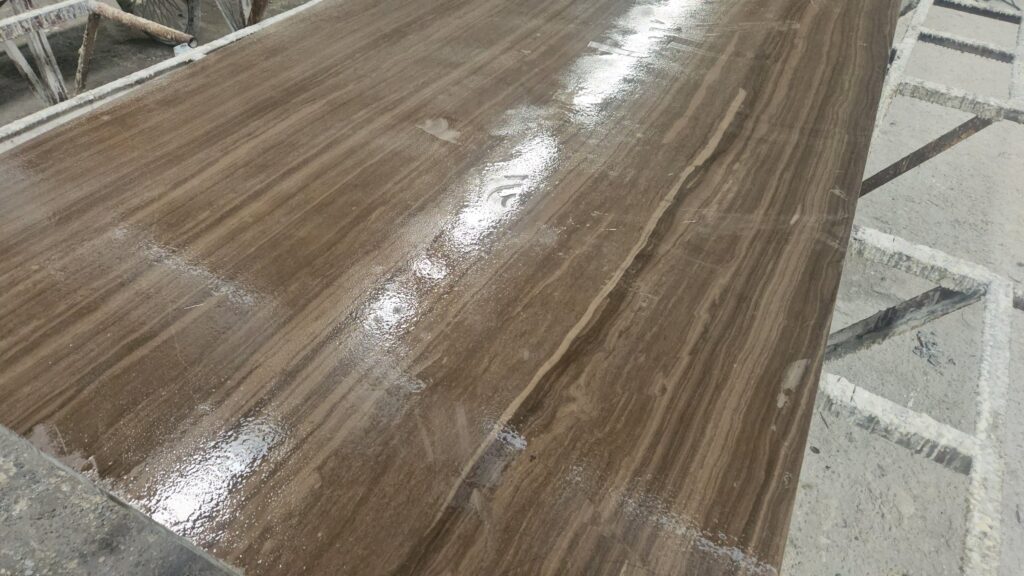

Reference photographs. They show the material and the finish; they are not photographs of goods we made, and the colour on screen is not a colour-match.
The figures, and where each one comes from
| What happened | What it is | What to do |
|---|---|---|
| A dull mark that will not wipe off | An etch | Polishing powder, or a stone restorer |
| A colour that soaked in | A stain | A poultice, by the type of stain |
| A mark around a tap | A water spot or an etch, and they need different treatments | Buff for a deposit; polish for an etch |
Why it behaves the way it does
The distinction decides the treatment and it is the one most often got wrong. A stain is something that went in and can be drawn out; an etch is the surface itself, dissolved, and nothing will bring it back except a mechanical polish.
What these figures are, and what they are not
This is general guidance for calcareous stone. A surface in a hotel kitchen or a bar has a cleaning programme that somebody has to own, and a stone-safe cleaner is a specification decision rather than a shopping one.
If you are specifying this
We have not published products against this question yet. Send us the process, thickness and quantity and we will quote it against what we can actually form, rather than against a catalogue.
At 0.3 to 0.4 per cent absorption it stains slowly rather than instantly, and most spills can be blotted off if they are caught. What it does do is etch, and an etch is not a stain — it is a layer of the surface that has to be polished back.
The figures
| What happened | What it is | What to do |
|---|---|---|
| A dull mark that will not wipe off | An etch | Polishing powder, or a stone restorer |
| A colour that soaked in | A stain | A poultice, by the type of stain |
| A mark around a tap | A water spot or an etch, and they need different treatments | Buff for a deposit; polish for an etch |
Why
The distinction decides the treatment and it is the one most often got wrong. A stain is something that went in and can be drawn out; an etch is the surface itself, dissolved, and nothing will bring it back except a mechanical polish.
What these figures are, and what they are not
This is general guidance for calcareous stone. A surface in a hotel kitchen or a bar has a cleaning programme that somebody has to own, and a stone-safe cleaner is a specification decision rather than a shopping one.